Market Growth, Industry Impact, and the truth behind the hype.

Executive Summary
AI in CRM has moved from experimentation to enterprise‑scale adoption. The market is expanding rapidly, driven by GenAI, Agentic AI, and Autonomous Engineers that convert CRM from a transactional system into a strategic intelligence platform. Yet, measurable ROI hinges on data readiness, process standardization, and adoption discipline.
Key Takeaways
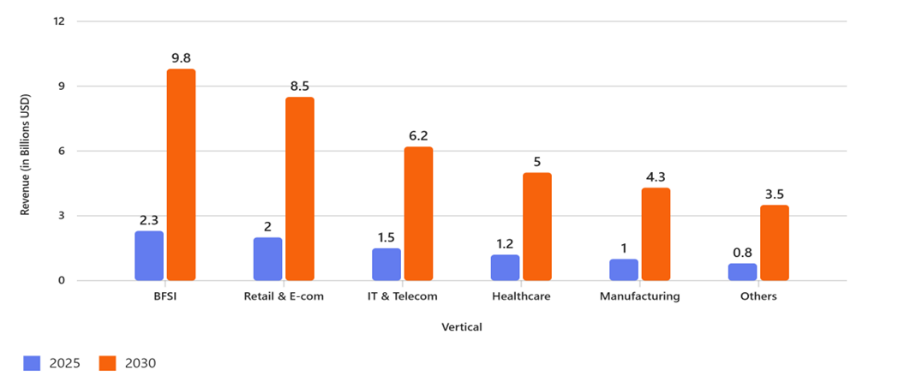
- The AI in CRM market is projected to grow from $4.1B (2023) to $48.4B (2033) at ~28% CAGR.
- Enterprise adoption continues to accelerate; McKinsey reports 88% use AI in at least one business function, with scaling still in progress.
- Success depends less on tools and more on data governance, process design, and change management.
- Mastek’s ADOPT.AI approach (AI for Technology / Business / Data) and its OpenAna partnership bring Autonomous Engineers and Agentic AI to enterprise CRM programs.
The Hype vs Reality: Where AI in CRM Delivers
The hype is loud, but the reality is nuanced. AI in CRM does deliver conversion lifts, productivity gains, and better customer experiences, especially when workflows are redesigned and data pipelines are robust.
McKinsey finds organizations using AI broadly, but only a third have begun to scale impact, underscoring the importance of process and adoption, not just pilots.

Market Reality: Growth and Outcomes
- Market Size & Growth. Global AI in CRM is forecast to reach $48.4B by 2033 from $4.1B in 2023 (~28% CAGR).
- Adoption Indicators. Industry briefs highlight accelerating adoption and revenue impacts, including faster responses and personalized engagements.
- AI‑enabled CRM reduces manual effort and improves throughput via predictive analytics, conversational AI, and agentic automation. High performers re‑architect workflows and embed AI in daily operations to unlock material gains in productivity and cost efficiency.
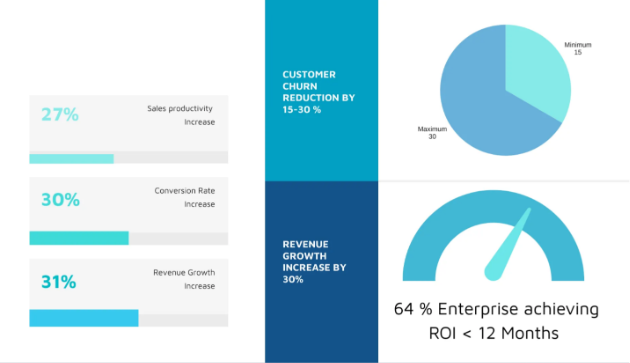
- AI-driven lead qualification & scoring improves conversion rates by 15–30%
- Sales productivity increases by approximately 27%
- AI-enabled sales teams generate 1.3x higher revenue growth
- Predictive recommendations reduce churn by up to 31%
- Hyper-personalized engagement improves customer satisfaction by up to 80%.
AI makes CRM interactions smarter and faster, from real‑time segmentation to proactive service which is improving loyalty and lifetime value. The shift to GenAI, Agentic AI enables autonomous orchestration across channels, compressing response times and enhancing personalization.
Operational Efficiency Gains Across Enterprises
AI within CRM delivers operational efficiencies at scale.
- Saves 13+ hours per employee per week through automation of data entry, follow-ups, and reporting
- Reduces customer onboarding time from 2 days to 15 minutes (automated workflows, risk scoring, validation)
- Cuts operational costs by 20–30% as per Mckinsey
- Reduces compliance costs by approximately 30%
- Eliminates up to 85% of manual data processing tasks
These efficiencies are driven by capabilities such as predictive analytics, workflow automation, machine learning models, conversational AI, and agentic AI systems.
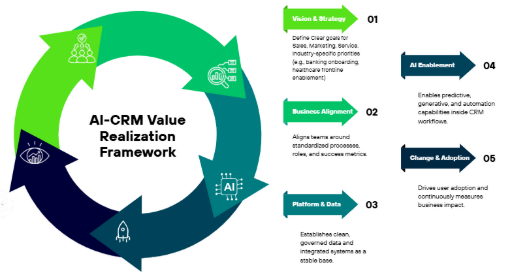
The AI‑CRM Value Realization Framework (Mastek Perspective)
Transformation succeeds when organizations progress through these stages:
- Vision & Strategic Intent: Align CRM to business outcomes across Sales (win rates, forecasting), Marketing (pipeline quality, personalization), Service (resolution times, CSAT), and industry‑specific KPIs.
- Business Alignment by Function: Build consensus on standards and use cases before tooling, preventing “feature chasing” and ensuring ownership by each function.
- Process Design & Standardization: AI doesn’t fix broken processes; redesign workflows (lead qualification, prioritization, escalation) and govern them end‑to‑end to avoid amplifying inconsistency.
- Platform & Data Enablement: Engineer data models, integrations, and hygiene (governance, enrichment, lineage) to make AI outputs trustworthy and actionable.
- AI Activation: Introduce GenAI, Agentic AI, and Autonomous Engineers only after platform and processes stabilize, so intelligence augments trusted workflows.
- Change Management: Treat AI as a behavioral shift: executive sponsorship, training, and continuous measurement produce durable ROI; pilots alone do not.
Industry Verticals Leading AI‑CRM Adoption
- BFSI (Largest share ~21.3%) using AI for fraud detection, risk scoring, credit decisions, predictive routing, and 24/7 service.
- Retail & E‑commerce (~19–20%) focusing on hyper‑personalization, dynamic pricing, and omnichannel journeys. [nikolaroza.com]
- IT & Telecom (~15%), Healthcare (~12%), Manufacturing (~10%) adopting AI for churn prediction, care pathways, service optimization, and warranty automation.
Mastek’s AI Roadmap: Turning Strategy into Scaled Impact
Mastek’s roadmap aligns to three pillars: AI for Technology, AI for Business, AI for Data, and is operationalized through ADOPT.AI, the AI Engineering CoE, and the AI Academy (3,600+ employees trained).
- AI for Technology: Accelerate SDLC with GenAI; boost quality and speed with Autonomous Engineers and co‑pilot tools.
- AI for Business: Embed agentic automation into CRM processes for personalized journeys, proactive service, and revenue optimization.
- AI for Data: Modernize data ecosystems for AI readiness, enabling trustworthy insights and compliant operations.
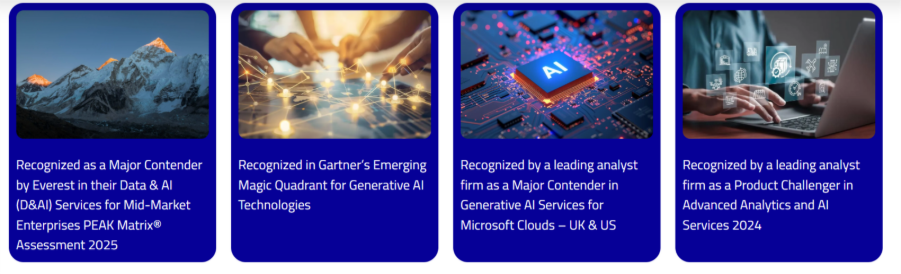
Mastek’s recognition (e.g., ET Making AI Work Awards 2025) underscores enterprise‑wide impact and a Lead with AI strategy
Strategic Guidance for Leaders and Investors
- Treat CRM as a strategic intelligence platform, not just a UI.
- Invest early in data hygiene & governance; poor data undermines predictions and recommendations.
- Align AI initiatives to clear business outcomes and measure persistently.
- Build change management programs (training, KPIs, adoption rituals) to turn pilots into scaled value.