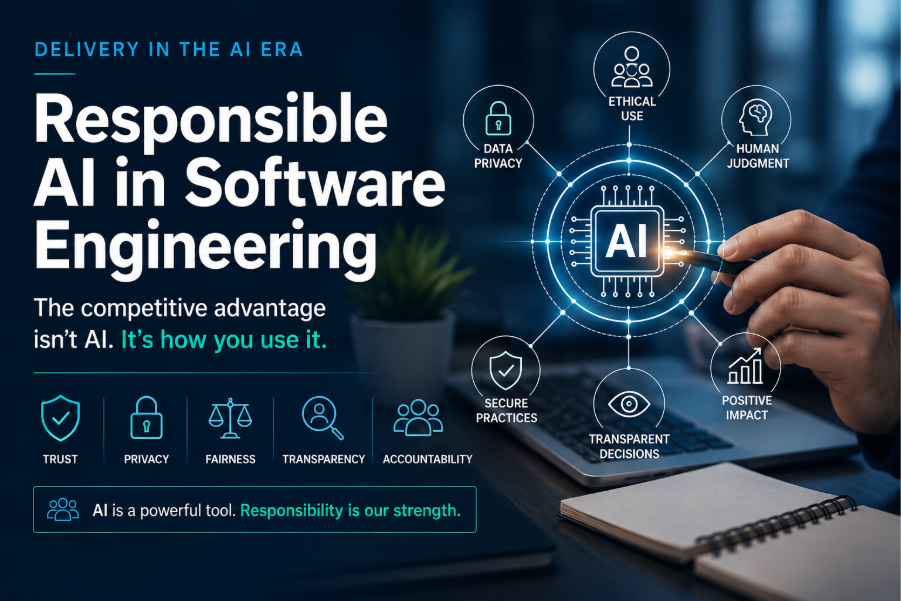
Artificial Intelligence won't replace great talent. But talent that knows how to leverage AI responsibly will redefine the future of software delivery.
Artificial Intelligence has rapidly evolved from an emerging technology into an everyday companion for software professionals. Today, it helps us generate code, review pull requests, create test cases, summarize requirements, prepare presentations, and even assist with architecture discussions.
The pace of adoption has been extraordinary.
As someone who has spent years leading delivery organizations and is now responsible for driving outcomes across multiple industry verticals, I see AI not merely as another technology shift, but as a transformation in how we build software, deliver value, and develop talent.
The opportunity is faster delivery, higher productivity, accelerated learning, and better customer outcomes.
The challenge is equally important. It isn't whether we should use AI, it's whether we know how to use it responsibly.
That is what inspired me to write this article, in which I'll share practical perspectives on how AI is reshaping software engineering leadership, engineering, and talent.
The competitive advantage has never been AI itself. It has always been, and will continue to be – the people who know how to use it responsibly.
– Karthik Hari
AI Should Accelerate Thinking & Not Replace It
I've observed two very different approaches to AI adoption.
Some professionals use AI to become better engineers, architects, testers, analysts, and consultants. They learn faster, explore new technologies with confidence, and deliver greater value.
Others have unintentionally become dependent on AI for almost every decision. Instead of using it as an accelerator, they've started using it as a substitute for thinking.
That's where Responsible AI becomes essential.
AI generates possibilities. Professionals must apply judgment.
When AI Is Solving the Wrong Problem
Responsible AI in software engineering isn't about avoiding AI. It's about knowing where human expertise must remain in control.
Some examples include:
-
Accepting AI-generated architecture recommendations without evaluating scalability, security, or operational impact.
-
Copying AI-generated code directly into production without understanding or validating it.
-
Estimating delivery timelines using AI without considering team maturity, dependencies, and business realities.
-
Uploading client source code, production logs, or confidential documents into public AI platforms.
-
Treating AI-generated user stories, test cases, or documentation as complete without validating them against actual business needs.
-
Using AI to answer questions that should first be solved through critical thinking, domain expertise, or collaboration.
None of these are failures of AI. They are failures of judgment.
Technology doesn't remove accountability, it simply changes how we exercise it.
Trust Is Still Our Greatest Deliverable
Every delivery organization is built on trust.
Clients trust us with their intellectual property, business processes, customer information, and strategic initiatives.
Before sharing information with any AI platform, every professional should ask one simple question:
"Am I authorized to share this information?"
Responsible AI begins long before the prompt is written. It begins with protecting client trust.
AI Will Not Replace Talent
One statement dominates almost every AI discussion:
"AI will replace software professionals."
I see it differently.
AI will automate repetitive work. It will compress learning curves. It will reshape job roles.
But it won't build customer relationships. It won't mentor engineers. It won't negotiate priorities. It won't take ownership of delivery outcomes.
People do.
The professionals who will thrive are those who combine technical depth, domain expertise, communication, leadership, and AI into a single capability.
The future belongs to professionals who know when to trust AI, and when to trust their own judgment.
The AI-Augmented Professional
Role consolidation is already happening across our industry.
Organizations increasingly need professionals who can contribute across engineering, testing, cloud, automation, security, and business domains.
The good news is that AI has lowered the barrier to learning.
Developers can understand cloud faster. Testers can learn automation more efficiently. Business analysts can analyze data with greater confidence.
AI opens doors. Continuous learning is what allows us to walk through them.
A Thought to Leave You With...
Responsible AI isn't a framework, a policy, or a checklist. It's a mindset.
Every prompt we write, every recommendation we accept, every line of AI-generated code we use, and every decision we make ultimately reflects our professional judgment.
Technology has always evolved faster than the way we work. AI is no different.
What will distinguish great delivery professionals isn't how frequently they use AI, but how thoughtfully they use it.
My hope with this series isn't to provide all the answers, but to start meaningful conversations that help us navigate this transformation together.
AI is changing how software is built. It is not changing why we build software.
Great delivery has always been about solving business problems, earning customer trust, and empowering talented people.
AI simply gives us a better set of tools.