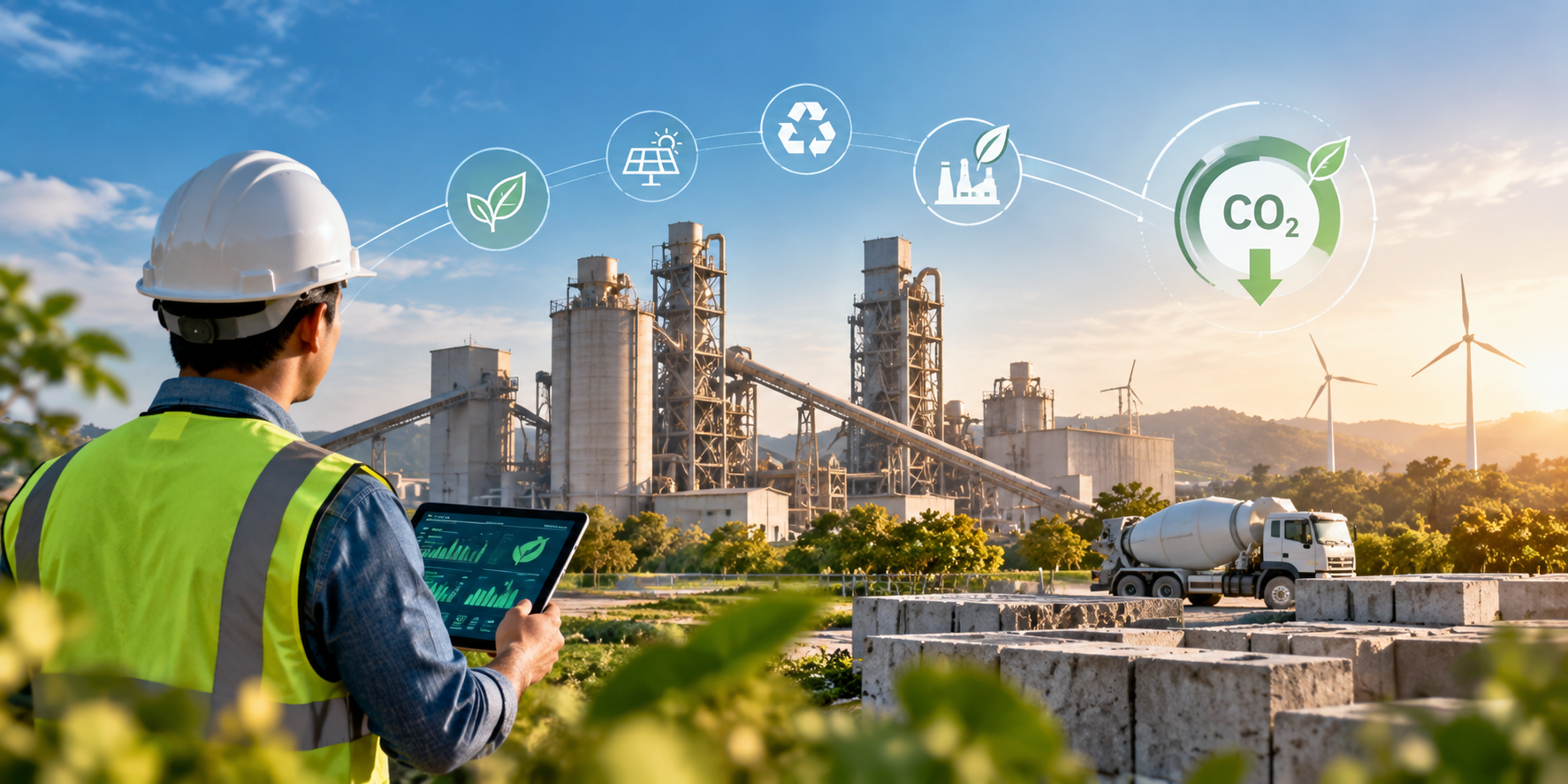
It is no secret that globally, cement and concrete manufacture is responsible for about 7% of CO2 emissions. Six years ago, the member organisations of the Global Cement and Concrete Association (GCCA) joined hands to commit themselves to bringing in carbon-neutral concrete by 2050, and to accelerate CO2 reductions. According to the Association, the roadmap actions that it has set out should prevent close to 5 bn tonnes of CO2 emissions will from entering the atmosphere by 2030.
The Cement Industry Federation (CIF), Australia’s primary industry association for manufacturers of clinker, cement and cement products, has mapped a science-based pathway to net zero by 2050. Based on the findings of its 2021 report ‘Decarbonisation Pathways for the Australian Cement and Concrete Sector, the country’s cement and concrete sector has shown a 25% reduction in its CO2 emissions between 2000 and 2020.
Both are good news for the cement and concrete industry. And critical too, especially as regulatory pressure is intensifying, and as investors and customers demand transparency in Scope 1-3 emissions. With help on the way in terms of government grants to fund low-emission tech pilots, the time is now to set in motion technology-driven cement decarbonisation pathways for net zero concrete.
Effective ways for cement and concrete decarbonisation
An undeniable fact is that concrete is essential in shaping and building a sustainable world for the future, in terms of infrastructure, homes, clean water and renewable energy. In fact, GCCA believes that a net zero strategy and action plan in the cement and concrete sector can limit global warming to 1.5°C with the right policies, technology levers, innovations and infrastructure.
The challenges to attaining this goal are significant. Cement manufacturing is associated with an inevitable Demand for energy and CO2 emissions is an inevitable reality given the physical and chemical characteristics of the cement production process. Breakthrough technologies in carbon capture, which are still in the pilot stages, are the need of the hour.
The cooperation of the entire value chain in cement and concrete production — comprising customers, developers, design, building material procurement, architecture, establishment of standards — is thus vital. The following pathways must be leveraged concertedly for cement and concrete decarbonisation:
1. Zero-emission electricity and transport through cost-effective renewable energy initiatives, and AI- and sensor-powered energy efficiency measures. For example, we delivered a connected enterprise services (CES) solution to a leading cement manufacturer in the Middle East for end-to-end digitalization of the entire order-to-dispatch lifecycle. Leveraging IoT Automated Number Plate Recognition (ANPR), unmanned weighbridges and real-time ERP integration, we transformed dispatch into a competitive advantage2. Innovative building and infrastructure design to achieve material efficiency, with lower carbon concrete and better construction technologies
3. Improving the concrete mix design and technology, such as optimizing of packing density and admixtures.
4. Leveraging the strengths and benefits of supplementary cementitious materials (SCM) in cement and concrete, create a market for low-CO2 concretes, and accordingly modify supply chain strategies. Simultaneously, increase clinker substitution – including fly ash, calcined clays, ground granulated blast-furnace slag (ggbs), and ground limestone.
5. Use of alternative fuels and green hydrogen to replace coal and gas to heat cement kilns, and application of efficient pre-processing technologies. For example, Cement Australia recently secured AUD 52.9M for kiln upgrades in Tasmania and partnered with Geocycle to process 60K+ tonnes of waste in 2023.
Next-gen technologies for cement decarbonisation
Two strategies can work in tandem to achieve effective cement decarbonisation.
One is the use of novel cements — for example, limestone calcined clay (LC3) to replace Portland clinker. This is an energy-efficient and cost-effective substitution that can effectively minimise process emissions. By 2023, this is projected to reduce concrete emissions by 40%, and save up to 500 mn tonnes of CO2 annually. Plus, by 2050, it is estimated to account for more than a quarter of cement used across the world. The The Cementos Argos plant in Colombia has demonstrated that this can be scaled for success. Bio-cement (algae-grown limestone and electric-recycled cement are other technological developments that have high potential. Additionally, improved design assumptions and methods can enhance the efficient use of binders in a structure.
The second is the deployment of Carbon Capture, Utilization, and Storage (CCUS) technologies to capture CO2 emissions from heavy industries and power plants, or directly from the air, for reuse or permanent underground storage. It is estimated that CCUS can eliminate 90 per cent of emissions in cement plants, and is regarded as a key and favoured measure to reduce the carbon emissions of cement production. Undoubtedly, CCUS in cement is still at an early stage and while no full-scale integration of CCUS has happened, its potential is undeniable.
Costs, infrastructure and policy support are real barriers to scalability of these technologies. The good news is that pilot projects are underway across the world, and we can hope to see visible scaling in the coming years.
Other breakthrough technologies on the horizon include
1. Renewable energy-powered electrified kilns and plasma heating, which can eliminate combustion emissions. Long-term deployment of plasma torches and microwave heating will depend on clean grid development and cost optimization measures, but it certainly holds promise.2. The use of CO2 to cure concrete and mineralise waste materials can make concrete carbon-neutral, and even carbon-negative.
3. While niche today, carbon capture technologies could well become an important tool to achieve circular construction. It does not decarbonize the sector on its own, but could prove valuable in using captured emissions that would be stored otherwise.
Tomorrow’s digitalised cement plants must also incorporate intelligent and unified data management to enable various interconnected AI applications act holistically towards net zero operations.
Achieving net-zero outcomes in cement and concrete demands significant technology innovation and investment. Creating the right CO2 infrastructure is therefore crucial for both decarbonisation of cement and concrete, and for development of new CCUS value chains. Simultaneously, avenues to scale existing technologies must be explored and acted on, so that tomorrow’s buildings are low-carbon and climate-resilient. In this regard, Australian manufacturers have purposefully set the wheels in motion with their efforts to demonstrate 30% improvement in thermal efficiency, 18% replacement of fossil fuels, introducing 40% biomass in alternative fuels, and a 38% reduction in clinker content and associated CO2 emissions in concrete.
And finally, public policy must support the industry and its comprehensive value chain. Industry leaders, policymakers and governments must join hands to make low-carbon cement manufacturing viable, stimulate the market and demand for low-carbon concrete products and support the establishment of a circular and net zero cement and concrete manufacturing environment.