
What is agentic commerce, and why does it change retail sales?
Agentic commerce is shopping in which AI shopping agents discover, evaluate and buy on a shopper’s behalf. It changes retail sales because the agent, not the shopper, picks the seller.
My conversations with retailers, restaurants and consumer brands increasingly come back to one question: how will the business serve a customer when the customer's next interaction may be with an AI agent rather than a website, app or store associate?
A shopper might ask an assistant for waterproof trail shoes, size 10, under $150, delivered by Friday. The agent can search across sellers, compare product attributes, price and delivery promises, and potentially complete the purchase. That is the shift.
The shift is already visible. In Deloitte's 2026 holiday survey of 4,000 U.S. consumers, 39% said generative AI is their primary tool for at least one holiday shopping task. And Adobe forecasts that clicks from AI sources to U.S. retail sites will rise 130% year over year this holiday season.
The platforms are moving too. In January, Google unveiled its Universal Commerce Protocol, a shared standard that lets AI agents shop for a customer, and Salesforce announced it will add support for it in Agentforce Commerce. On Oct. 21, Walmart announced spending limits shoppers can set for AI agents, plus its own rules for what those agents can do across Walmart and Sam’s Club.
These signals point to a changing path to purchase. They also set a new requirement: retailers must make their businesses discoverable, dependable and transactable across AI-led experiences.
But agentic commerce should not be viewed as another digital channel to bolt onto the existing estate. It exposes whether a retailer has achieved the deeper integration that unified commerce has always required. If product information, pricing, inventory, promotions, fulfillment and customer commitments are fragmented across systems, an AI agent will encounter those inconsistencies just as customers and employees do today.
Key takeaways
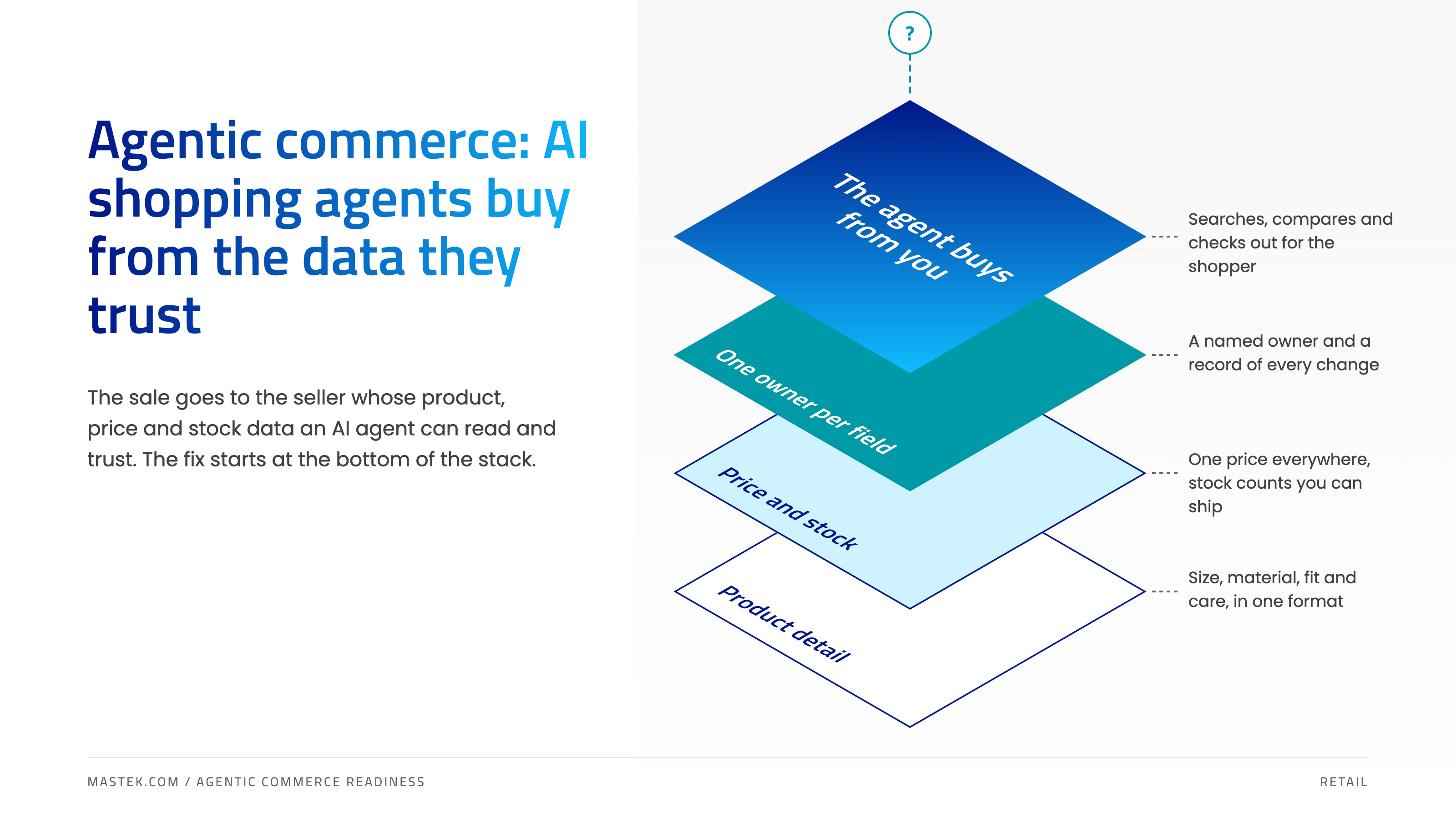
- AI shopping agents pick the seller whose product, price and stock data they can read and trust. Unclear data can cost the sale before a shopper ever sees your site.
- Agentic commerce is changing how shoppers discover, evaluate and purchase products. Retailers must make their products, prices, availability and policies understandable and actionable by AI agents.
- Winning in this environment depends on unified commerce: consistent customer, product, pricing, inventory, order and service experiences across stores, digital channels, marketplaces and emerging AI interfaces.
- The foundations extend across the enterprise, from merchandising, data and digital experience to ERP, order management, supply chain, store operations, finance and cybersecurity.
- Retailers should treat AI readiness as an enterprise transformation agenda, supported by clear business outcomes, modern architecture, trusted data, responsible AI and continuous operations.
- Mastek helps from the product record to the sale.
- Mastek connects commerce, enterprise data, ERP and AI capabilities to support agentic commerce readiness.
Why does agentic commerce depend on unified commerce?
Agentic commerce depends on unified commerce because an AI agent needs the same trusted product, price, inventory and order information that every channel needs.
Many retailers have invested in omnichannel capabilities: web, mobile, marketplaces, stores, contact centers, click-and-collect and ship-from-store. Yet having multiple channels does not necessarily mean the business operates as one. Customers still experience disconnected promotions, inconsistent availability, limited order visibility, repeated service interactions or different experiences depending on where a transaction begins.
Unified commerce moves beyond channel connectivity. It brings customer, product, price, inventory, order, payment and service information together through connected processes and a coherent technology foundation. A customer should be able to discover a product online, check accurate local availability, purchase through a preferred channel, collect or receive it through the most suitable fulfillment option, and get consistent support afterward.
That same foundation becomes essential when an AI agent enters the journey. The agent needs trusted product attributes, current pricing and promotions, accurate inventory, clear delivery and return policies, and a reliable way to complete and track an order. The retailer must be able to deliver one consistent answer, regardless of whether the interaction starts in a store, on a website, in an app, on a marketplace or through an AI assistant.
In this sense, agentic commerce is not separate from unified commerce. It is another experience layer that depends on the same enterprise capabilities, with higher expectations for data quality, real-time integration, policy enforcement and transaction reliability.
What enterprise transformation does agentic commerce require?
Agentic commerce requires coordinated change in six areas: customer experiences, data, order management, ERP and supply chain, AI controls, and integration.
Delivering unified commerce at scale requires more than a storefront refresh or a new AI tool. It calls for coordinated transformation across the front, middle and back office, with business and technology teams working toward shared outcomes.
1. Customer, digital and store experiences
Retailers need connected experiences across e-commerce, mobile, marketplaces, contact centers and physical stores. That includes consistent product discovery, promotions, pricing, loyalty, checkout, returns and customer service. Store associates also need access to the same customer, product and order context so they can support journeys that move between digital and physical touchpoints.
2. Product, customer and enterprise data
A trusted data foundation is critical. Product attributes, variants, dimensions, availability, customer preferences and supplier information must be governed consistently, with clear ownership and quality controls. Master data management, data integration, analytics and AI-ready data products help reduce conflicting records and make information usable across channels and business functions.
3. Commerce, order management and fulfillment
The commerce layer must connect directly to order management, inventory, warehouse, transportation and store systems. This enables capabilities such as buy online, pick up in store, ship from store, endless aisle, flexible returns and intelligent order orchestration. It also ensures that the availability and delivery promise presented to a shopper or agent reflects what the enterprise can actually fulfill.
4. ERP, merchandising and supply chain modernization
Unified customer experiences depend on resilient core operations. Retailers should assess how ERP, merchandising, finance, procurement, supply chain and store operations support the target business model. Modernization may involve simplifying legacy platforms, moving appropriate workloads to cloud, improving process integration and strengthening operational visibility, all while protecting business continuity.
5. AI, automation and responsible governance
AI can support personalization, demand forecasting, service, associate productivity, software engineering and decision automation. As agents begin to transact, retailers also need clear controls: which agents are permitted, what actions they can take, what spending or product limits apply, how identity is verified, and how exceptions are monitored. Security, privacy, auditability and human oversight must be designed into the operating model.
6. Integration, resilience and continuous operations
A unified experience is only as dependable as the systems behind it. Retailers need integration patterns, API management, observability, cybersecurity, quality engineering and resilient operations that support peak trading as well as day-to-day execution. The objective is not simply to launch transformation programs, but to sustain measurable improvements after go-live.
Why do AI shopping agents pass over some retailers?
AI shopping agents pass over a retailer when its product, price or stock data is missing or conflicting, or when its bot protection blocks them.
Consider the trail-shoe request. The product catalog describes the shoe as waterproof, but the structured material attribute is missing. The commerce platform shows one price while a marketplace feed carries an older one. The inventory service reports stock, but the warehouse cannot meet the promised delivery date. A human shopper may investigate further or contact customer service. An AI agent may simply select another retailer.
Some retailers lose before any of that matters. In a September test by the agency Blend, 29 of 200 U.K. and U.S. retailers refused an unmodified automated browser, which Blend attributes to bot protection. A firewall built to stop scrapers can turn away the AI shopping agents you want too.
These are not isolated data defects. They are symptoms of disconnected ownership, processes and platforms. Merchandising, e-commerce, supply chain, store operations, finance and IT may each maintain systems optimized for their own responsibilities. Unified commerce requires those teams to agree on common business definitions, accountable data owners, integration priorities and end-to-end performance measures.
The retailers that get this right have a reason to move fast. In July, AI referral traffic to U.S. retail sites rose 62% year over year, according to Adobe data reported by Digital Commerce 360. Adobe also reports that AI-referred visits convert 60% higher than other traffic and generate 53% more revenue per visit.
The commercial impact extends beyond AI referrals. The same improvements can strengthen onsite search, marketplace performance, inventory accuracy, order promise reliability, associate effectiveness and customer service. Retailers should therefore build the business case around enterprise-wide value rather than treating agentic commerce as a narrow channel investment.
How should retailers prepare for agentic commerce?
Prepare in seven steps: set outcomes, map the value chain, test the AI shopping journey, focus on high-value categories, build a roadmap, set agent governance and measure value.
Start with the customer and business outcomes. Identify the journeys that matter most, such as product discovery, availability, checkout, fulfillment, returns and service. Then define the experience the retailer wants to deliver consistently.
Assess the end-to-end commerce value chain. Map where product, price, promotion, inventory, order and customer data originate, how they move, who owns them and where inconsistencies affect decisions or customer promises.
Test the AI shopping journey. Use major AI assistants to search for and, where supported, attempt to purchase priority products. Record whether products are discoverable, attributes are interpreted correctly, prices and availability are accurate, and policies are clear. Start with your best sellers. Log which field caused each miss, then fix product details first, price second and stock third. Rerun the same test every week.
Prioritize a focused set of high-value categories and journeys. Resolve the data and integration issues that have the greatest impact rather than attempting a broad, unsequenced cleanup.
Build a unified commerce roadmap. Align digital commerce, stores, order management, supply chain, ERP, data and AI initiatives around a target architecture and sequenced business outcomes.
Establish agent and AI governance. Define permitted agents, authentication and authorization expectations, transaction limits, exception handling, monitoring and accountability. Confirm how the retailer will remain merchant of record and manage the associated obligations. Under the Universal Commerce Protocol, the retailer stays the merchant of record. It carries the financial liability and owns the order, even when an agent places it.
Measure value continuously. Track conversion, order promise accuracy, inventory accuracy, fulfillment cost, returns, service outcomes, AI-assisted traffic and agent-initiated transactions where measurable.
Retailers do not need to transform every platform at once. They do need an enterprise view of the destination, a prioritized roadmap and the discipline to modernize interconnected capabilities in the right sequence.
Nor do they need to bet on one standard. In June, payments provider Adyen launched agentic commerce tools for U.S. enterprise merchants, initially on a limited basis, and backed three protocols: Google’s Universal Commerce Protocol, the Agent Payments Protocol and OpenAI’s Agentic Commerce Protocol. Ask your commerce platform and payments provider which ones they support today. Then focus on the data every protocol reads.
How Mastek Helps Retailers Prepare for Agentic Commerce
Mastek helps retailers get ready for agentic commerce by connecting its commerce, data, Salesforce, Oracle and AI teams in one program.
Mastek works with retailers and brands across digital commerce, enterprise applications, data and AI, and modernization. Our focus is to connect customer-facing innovation with the enterprise capabilities required to make it work at scale.
In digital commerce, Mastek designs and delivers commerce experiences across platforms including Salesforce Commerce Cloud and Oracle CX Commerce, supporting B2C, B2B and D2C models. The work extends beyond the storefront to connect commerce with ERP, CRM, order management and other enterprise systems. That way one price travels from the product record to the page, the marketplace feed and checkout. On Salesforce Commerce Cloud, Mastek also streamlines order orchestration, inventory visibility and fulfillment across channels, so the stock an agent reads is the stock you can ship.
Our Data and AI capabilities help retailers strengthen data foundations, establish ownership and governance, improve data quality and apply analytics and AI to business processes. Our Salesforce capabilities bring together commerce, customer engagement and AI-enabled processes. Our Oracle teams help modernize enterprise applications, ERP, store operations and supply chain platforms, with attention to business continuity and operational outcomes.
Mastek also brings capabilities in enterprise AI, quality engineering, automation, integration and managed services. These are important to operationalize AI responsibly, improve release confidence, strengthen resilience and support the environment beyond implementation.
The opportunity is to bring these capabilities together through a transformation roadmap shaped around the retailer’s priorities, rather than pursuing disconnected technology projects. That means aligning business strategy, customer experience, operating model, data, applications and delivery governance, then measuring progress against outcomes such as growth, margin, availability, speed and customer satisfaction.
Why Unified Commerce Is the Next Competitive Advantage
The retailer that wins the next phase of commerce will not necessarily be the one with the newest AI feature or the most channels. It will be the one that can make a reliable promise and keep it wherever the customer chooses to engage.
When a shopper asks for a product, the retailer’s data should make it discoverable. When the shopper checks out, pricing and availability should be accurate. When the order is placed, the enterprise should orchestrate fulfillment reliably. And when an AI agent participates, the retailer should retain the controls, visibility and accountability needed to serve the customer with confidence.
That is the strategic opportunity in front of retail leaders: move from channel integration to unified commerce, and from isolated technology upgrades to enterprise transformation. Agentic commerce makes the urgency visible. The underlying work will make the retailer stronger across every channel and every customer interaction.
Frequently asked questions
What is agentic commerce?
Agentic commerce is shopping in which AI agents act on a shopper’s behalf to discover products, compare options and, where supported, complete transactions. Agents rely on structured, trustworthy information such as product attributes, price, availability, delivery and return policies. Retailers need connected data and transaction capabilities to participate effectively.
How is unified commerce different from omnichannel commerce?
Omnichannel commerce connects customer touchpoints such as stores, websites, mobile apps and marketplaces. Unified commerce goes further by connecting the data, platforms and processes behind those channels, including customer, product, pricing, inventory, orders, payments and service, so customers and employees receive a consistent experience across the journey.
Why does agentic commerce require enterprise transformation?
AI agents depend on accurate information and reliable transactions across multiple systems. Product data, pricing, inventory, fulfillment, payments and policies often sit across separate platforms and teams. Enterprise transformation aligns these capabilities, modernizes integration and governance, and helps ensure the promise made to a customer or agent can be fulfilled.
How should retailers modernize front-office and back-office systems together?
Modernize front-office and back-office systems together by starting with priority customer journeys and tracing the information and processes behind them. Identify the systems of record for product, price, inventory, customer and orders; assign clear ownership; and connect commerce to ERP, order management, supply chain and store systems. Sequence modernization around measurable business outcomes and operational continuity.
How can retailers prepare their data for AI shopping agents?
Prioritize accurate, structured and governed product attributes, pricing, availability, delivery and return information. Test priority products through major AI assistants, record discovery or transaction gaps, correct the underlying data and integration issues, and repeat the tests. Establish data ownership and controls so quality is sustained as catalogs and operations change.
How do you test whether AI assistants can find and buy your products?
Retailers test by asking the major AI assistants to find and buy their best-selling products. Log where the retailer appears, what the assistants get wrong and which field caused the error. Then fix the field, starting with product details, price and stock, and repeat the test every week.
How Can Retailers Govern and Control AI Shopping Agents?
Retailers can govern AI shopping agents by defining clear access permissions, data usage policies, spending limits, and approval requirements for purchases. Continuous monitoring, audit trails, and security controls help ensure agents operate within business rules. Combining these safeguards with human oversight enables retailers to protect customer data, prevent unauthorized transactions, and maintain control over AI-driven shopping experiences.
Which Salesforce Commerce Cloud and Service Cloud partners work with U.S. retailers?
Mastek designs omnichannel commerce for U.S. retailers on Salesforce Commerce Cloud and Oracle CX Commerce. That work connects the storefront to the ERP, order management and CRM systems that hold price, stock and orders. Mastek also sets clear rules for what AI can and can’t do, keeps data secure and records every decision.
How does Mastek support unified commerce and enterprise transformation?
Mastek brings together digital commerce, Salesforce, Oracle, Data and AI, enterprise AI, quality engineering, automation and managed services. These capabilities help retailers connect customer experiences with the enterprise applications, data and operations behind them, and execute a transformation roadmap aligned to business priorities.
Get your catalog ready for agentic commerce
If AI shoppers pass over your products today, our retail team can help you find the gaps that cost the sale.