
A role that feels new - but isn't
Open LinkedIn and browse for just five minutes — and you will meet the Forward Deployed Engineer. Training institutes advertise FDE bootcamps. Services firms announce FDE academies. Enterprises quietly reclassify senior developers under the new banner. Postings for "Forward Deployed Engineer" and its variants have grown by an increasing order of magnitude year on year.
Palantir created the role in the early 2010s - known internally as "Delta." By 2016, it had employed more forward-deployed engineers than traditional software engineers. What happened in 2025 was not an invention of the role but a revival: frontier AI labs discovered that their product was too powerful, too general, and too unfamiliar for customers to adopt unaided.
This distinction matters. It tells us that the FDE is not an artefact of the AI cycle. It is a proven answer to a specific, recurring problem: what do you do when your product is genuinely capable, but your customer cannot see the path from capability to outcome? Palantir faced it with data integration. OpenAI and Anthropic face it now with models. The answer both times is the same — stop sending a slide deck and sending an engineer.
What Is a Forward Deployed Engineer?
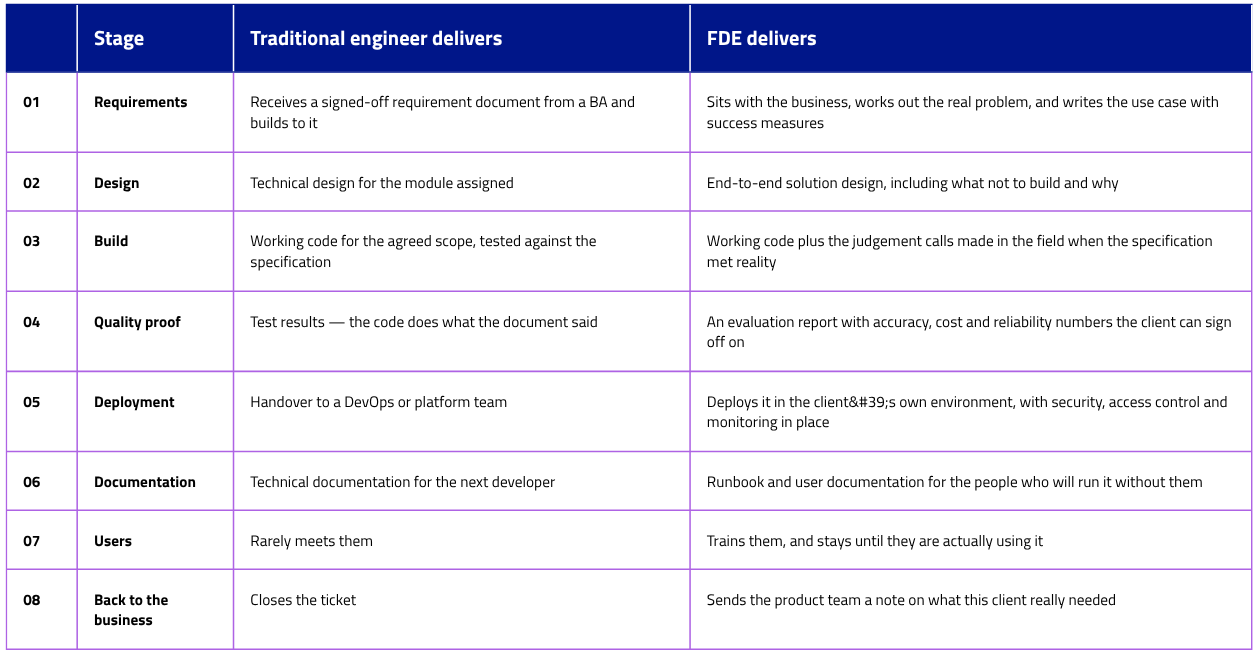
A Forward Deployed Engineer is a production-grade engineer who sits on the customer's side of the table, owning everything from requirement discovery to end-user enablement — unlike a consultant, they write production code; unlike a solutions engineer, they own the delivery outcome.
The composite is often written as:
Business Analyst + Solution Architect + AI Engineer + DevOps + Trainer
Composite roles are easy to describe and hard to hire, so here’s a sharper definition by contrast:
1. Unlike a consultant, an FDE writes production code that runs in the client’s environment.
2. Unlike a sales/solution engineer, an FDE owns the delivery outcome, not the deal.
3. Unlike a delivery engineer, an FDE carries a mandate to change the core product.
When an FDE customizes for one client, the customization does not die on that account — it is captured as signal. Across many clients in one domain, those signals cluster, and the cluster becomes a roadmap item. The FDE is the product company’s highest-bandwidth sensor pointed at reality.
The work is less glamorous than the title suggests. Industry survey data from 2026 puts a typical Forward Deployed Engineer week at roughly 47% customer-facing, 31% writing and reviewing code, and 22% internal coordination. Only about 6% build greenfield products.
Forward Deployed Engineer Training: A Realistic Curriculum
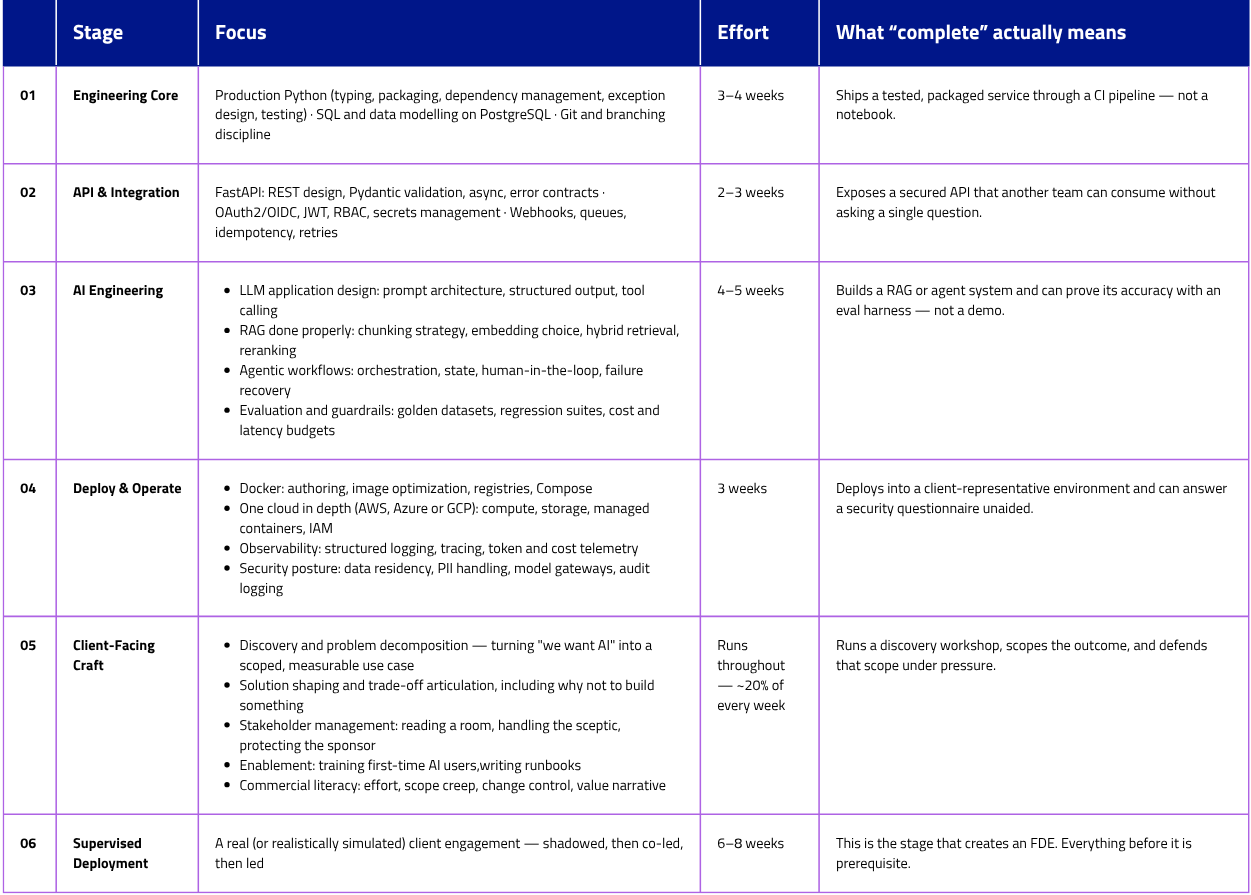
This is where most FDE training programs go wrong. They publish a technology checklist, compress it into six weeks, and produce a graduate who can recite LangGraph but freezes when a CIO challenges the architecture in a steering committee.
A credible curriculum has three things that a checklist does not: an entry gate, staged progression, and a supervised deployment.
Entry gate - verified, not taught
- 1. Four or more years inside a real delivery lifecycle, with production code shipped and supported.
- 2. Working fluency in at least one business domain — BFSI, retail, healthcare, manufacturing, supply chain.
- 3. Demonstrated comfort with ambiguity: has scoped something that arrived undefined.
- 4. Communication capability that survives a room with no allies in it.
Freshers should not be admitted — not for lack of talent, but because the role’s core skill is judgement under ambiguity, and because judgement is compounded experience. It cannot be front-loaded in a classroom.
The staged curriculum
Forward Deployed Engineer vs traditional engineer — what each one hands over
So, who can actually become a Forward Deployed Engineer?
The honest answer varies sharply by starting point, and most conversion plans are far too optimistic.
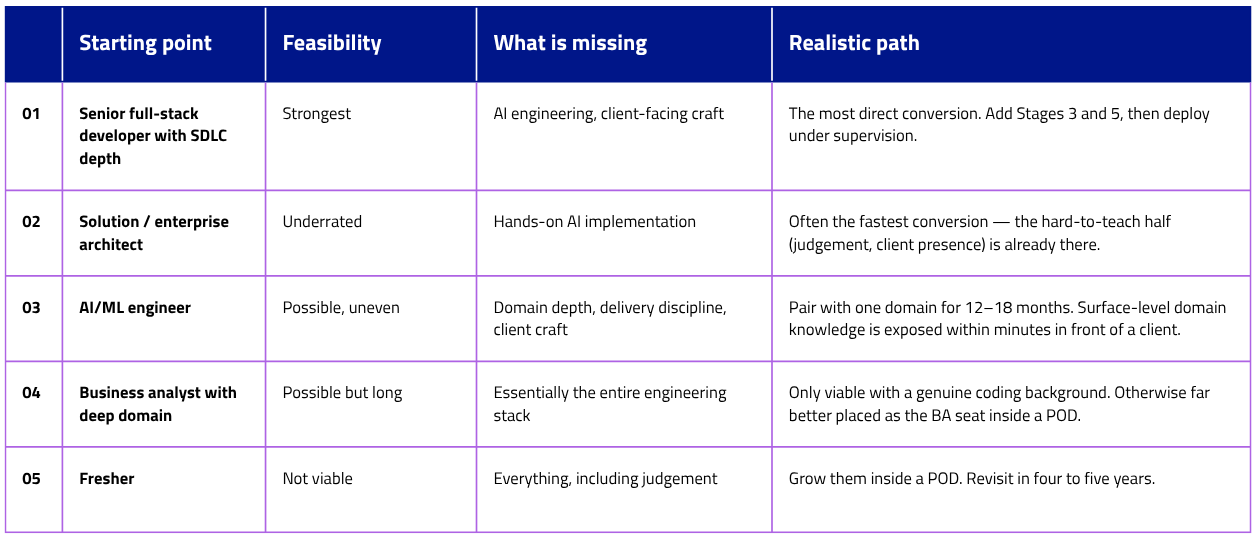
The pattern underneath the table is worth stating plainly: the scarce ingredient is not Python or LangGraph. Those are teachable and quick. The scarcity is the combination of production engineering credibility and the composure to sit across a client’s CXO and be believed. Most organizations budget generously for the first half and assume the second.
So - hype, or real value?
Both. And the entire distinction lies in how we prepare the team for the battle. Forward Deployed Engineer Curriculum plays the key role.
The value is real. The FDE has more than a decade of evidence behind it, at meaningful scale, and well before the current cycle made it fashionable. The problem it solves — the gap between what a capable product can do and what a customer can actually get it to do — is permanent, rather than seasonal. And the skillset is coherent rather than arbitrary: every element on the curriculum is there because some deployment, somewhere, failed without it.
The hype is in the compression. A title can be adopted in the afternoon. A six-week syllabus can be printed in a week. What cannot be compressed is the operating model underneath it — the entry gate, the staged depth, the supervised deployment, and the authority to actually change things. That takes months per individual and years to build institutionally. Where the vocabulary is adopted and the model is skipped, nothing structural has changed: engineers have been renamed and a slide has been updated.
Which reduces the strategic question to something simpler than "should we build Forward Deployed Engineers?" - Are we building the capability, or adopting the label?