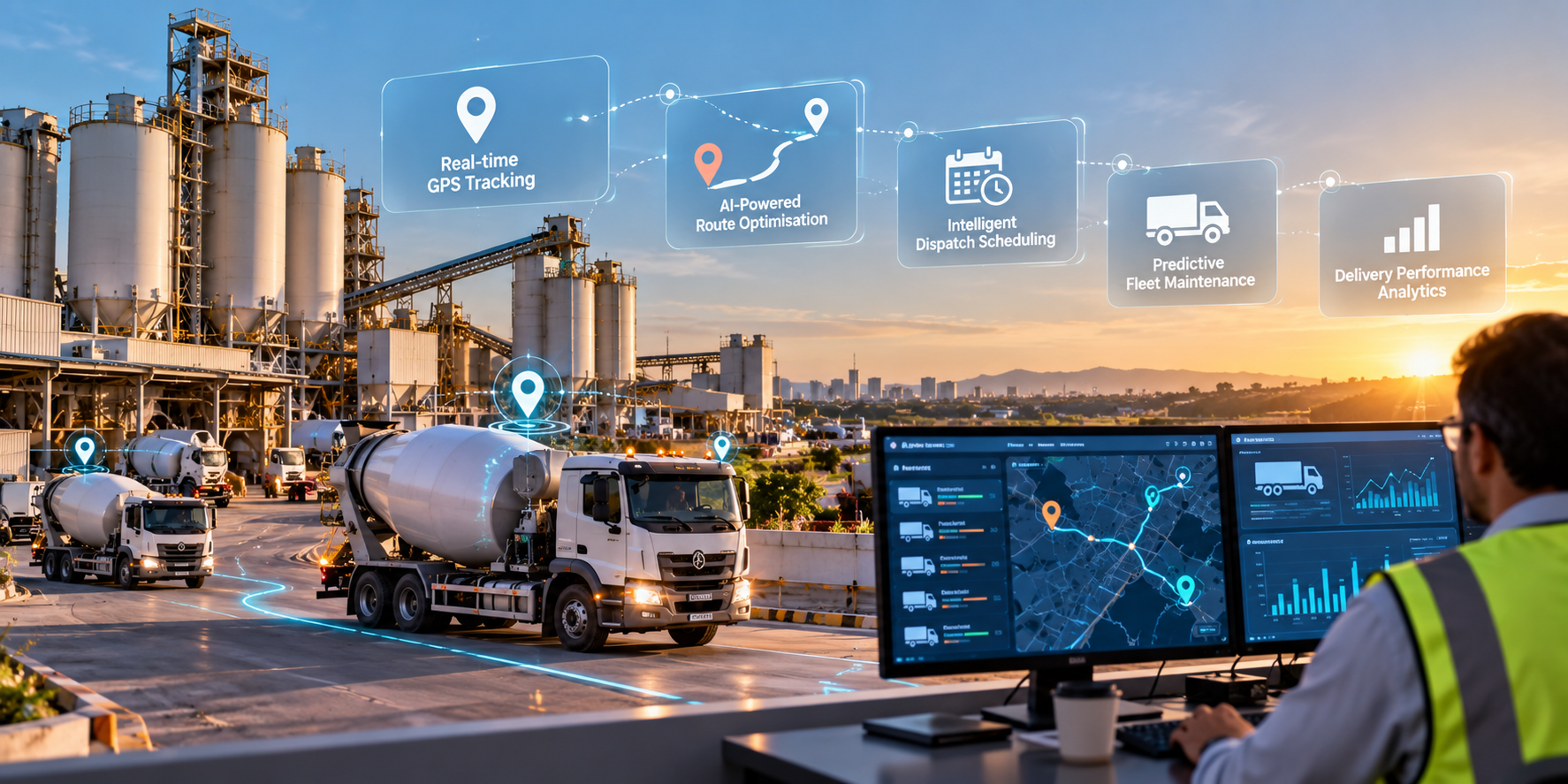
Imagine this situation. A concrete-producing truck, equipped with GPS tracking is on its way to a site to make a delivery. The delivery window is, say, 2 p.m. and the GPS tracking pinpoints the current location at 11 30 a.m. Now, there is information from the site that there is a delay and that the supply is needed only after two days. Here is where the distinction between location tracking and operational intelligence matters. The latter will confirm if the truck can be re-routed to another site for its requirement, thus saving transportation cost.
Take another scenario where such intelligence flags the truck’s drum motor drawing significantly more current than normal. It forces the logistics company to evaluate whether it should be pulled out for inspection or run the risk of breakdown while in the process of delivering a full load of hardening concrete.
This is the value of cement dispatch software and intelligent logistics automation in cement fleet management. Here, the factors of real-time GPS, telematics data, route optimisation with AI-driven cement dispatch scheduling, fleet health monitoring and delivery performance analytics work in close unison and interconnectedness to significantly reduce transportation cost and eliminate delivery failures. For an organisation such as Cement Australia that handles 10M+ tonnes annually with 220K+ truck movements, this could phenomenally accelerate turnaround times.
Interconnected capabilities for efficient cement logistics management
Logistics management in the cement industry is extremely time-critical and margin-sensitive. Even small delays for a loaded transit mixer can result in rejection and wastage of the particular batch — not to mention customer dissatisfaction and fractured relationships. Fleet management for this industry calls for the following interconnected capabilities that operate simultaneously:
1. Integration of real-time GPS and telematics data with route optimization2. Intelligent automation dispatch scheduling that re-sequences deliveries in an agile and dynamic manner in response to unforeseen disruptions
3. Efficient and real-time monitoring of fleet health that proactively identifies and addresses signs of troubles before they become delivery failures
4. Comprehensive and nuanced performance analytics that provide heads of operations accurate insights regarding cycle-time efficiency across the distribution network
The critical role of AI-powered fleet management and cement dispatch platforms designed specifically for cement logistics cannot be underestimated. GPS tracking, scheduling of delivery, optimization of routes, and predictive fleet maintenance must be integrated into a seamless unitary intelligence layer that is so critical for real-time visibility in distribution networks.
This is exactly how we transformed cement dispatch operations for Yanbu Cement. Deploying IoT, ANPR, unmanned weighbridges and real-time ERP integration, GPS tracking and Oracle Fusion integration, we achieved 2x truck turnaround improvement, eliminated weighbridge disputes, and delivered a fully automated 24×7 dispatch system.
Core capabilities to address operational realities of cement distribution
Dispatch and distribution are primary revenue-recognition moments for cement plants. And while they have invested heavily in ERP, this function largely runs on paper and manual weighbridge entries. This causes huge margin leaks due to:
1. Time lost in trucks waiting at weighbridges
2. Shipping disputes due to manual data entries
3. Incorrect silo allocation
4.Lack of real-time visibility between plant operations and ERP
Here are five key capabilities that need to be developed to address the operational challenges of cement dispatch.
Real-time fleet tracking equipped with industry-specific intelligence
Beyond just location tracking, the cement dispatch software needs to be connected to vehicle telematics. This will provide dispatchers a real-time picture of the truck’s capacity, whether it is on site, in transit, pouring or washing out, etc. Geofence-driven automation of status with IoT-embedded drum rotation can achieve this.
AI-led route optimization for cement delivery
This can embed critical factors for regulatory requirements such as (a) limits on bridge weight, (b) restrictions on loads on different roads, (c) delivery time-windows set for urban locations (d) limitations on access at different sites, (e) fuel-efficient and safe routes to take, (f) time-sensitivity of ready-mix concrete with respect to dispatch distances, and more.
Intelligent and dynamic scheduling
It could be last-minute orders, or contractors shuffling delivery schedules, or various other disruptions that need to be addressed during dispatch. This digital dispatch system can re-sequence dispatch, and delivery schedules in real-time are a critical must — and this must be integrated with risk management of alternate decisions to be made, all in real-time too. An integrated platform to address all eventualities is important.
Integration of predictive fleet maintenance
Cement logistics cannot afford instances of mid-route truck breakdowns, and more so, if they are carrying hardened loads. Predictive health monitoring and management of trucks must be embedded into the system’s dispatch planning layer — in terms of engine diagnostics, mileage data, driver inspection reports and OBD (on-board diagnostics) data.
Demurrage and delivery performance analytics
Demurrage or the charge for waiting time is a vital revenue factor in cement logistics, and also a heavily contested one. An analytics platform that will automatically log arrival, departure and waiting times of trucks will go a long way in enhancing the accuracy of delivery tickets. Such a system can also be programmed to provide real-time dashboards and valuable insights on cycle time breakdowns across routes.
An AI-powered cement dispatch software can deliver immense value across all the above capabilities. An integrated architecture encompassing IoT, ANPR, GPS tracking and ERP systems (as we did for Yanbu cements) can create end-to-end interconnectedness between production schedules, inventory silos, vehicle capacity, driver availability, delivery route efficiency, and maintenance work orders.
An implementation blueprint to maximize ROI
A practical starting point would be to integrate existing vehicle telematics and fleet management systems through standard APIs. This will avoid the need to replace hardware for vehicles that are already equipped with GPS devices (for vehicles without telematics, plug-and-play OBD devices, and GPS trackers can be installed). Drum rotation sensor integration for transit mixer fleets should also be implemented at this point.
Next to consider would be route network configuration, with geofencing of customer sites, embedding data on bridge weight restrictions, urban delivery regulations, configurations of plant loading zones, etc.
Dispatch workflow can now be integrated with order management systems so that confirmed delivery orders can be automatically pulled into the scheduling engine. Deployment of driver apps will complete the dispatch scheduling.
And finally, a comprehensive analytics layer must be activated that provides data and insights across the complete dispatch cycle — routes and driver performance, demurrage, fleet utilization, predictive maintenance, etc.
The Australian market has seen a digital push in cement dispatch and logistics, driven by demand in infrastructure, rising pressures of decarbonization, and realignment of supply chains. The government has increased its focus on large-scale transport and energy projects, leading cement producers to scale their operations and invest in digital optimization for logistics. Intelligent automation is thus no longer a competitive edge in cement dispatch and logistics, but an imperative baseline for survival in a market that is defined by perishable products, tight delivery windows, and vast Australian distances. Whiteboards and radio chatter must give way to AI-driven, sensor-integrated dispatch platforms so that the industry shifts to predictive orchestration for tangible gains in revenues, productivity and efficiency. As decarbonization pressures and infrastructure-led demand continue to reshape the sector, organizations that embed AI-powered analytics, real-time visibility, and IoT-enabled fleet intelligence, will be best positioned to turn logistics from a cost center into a genuine differentiator of operational excellence.